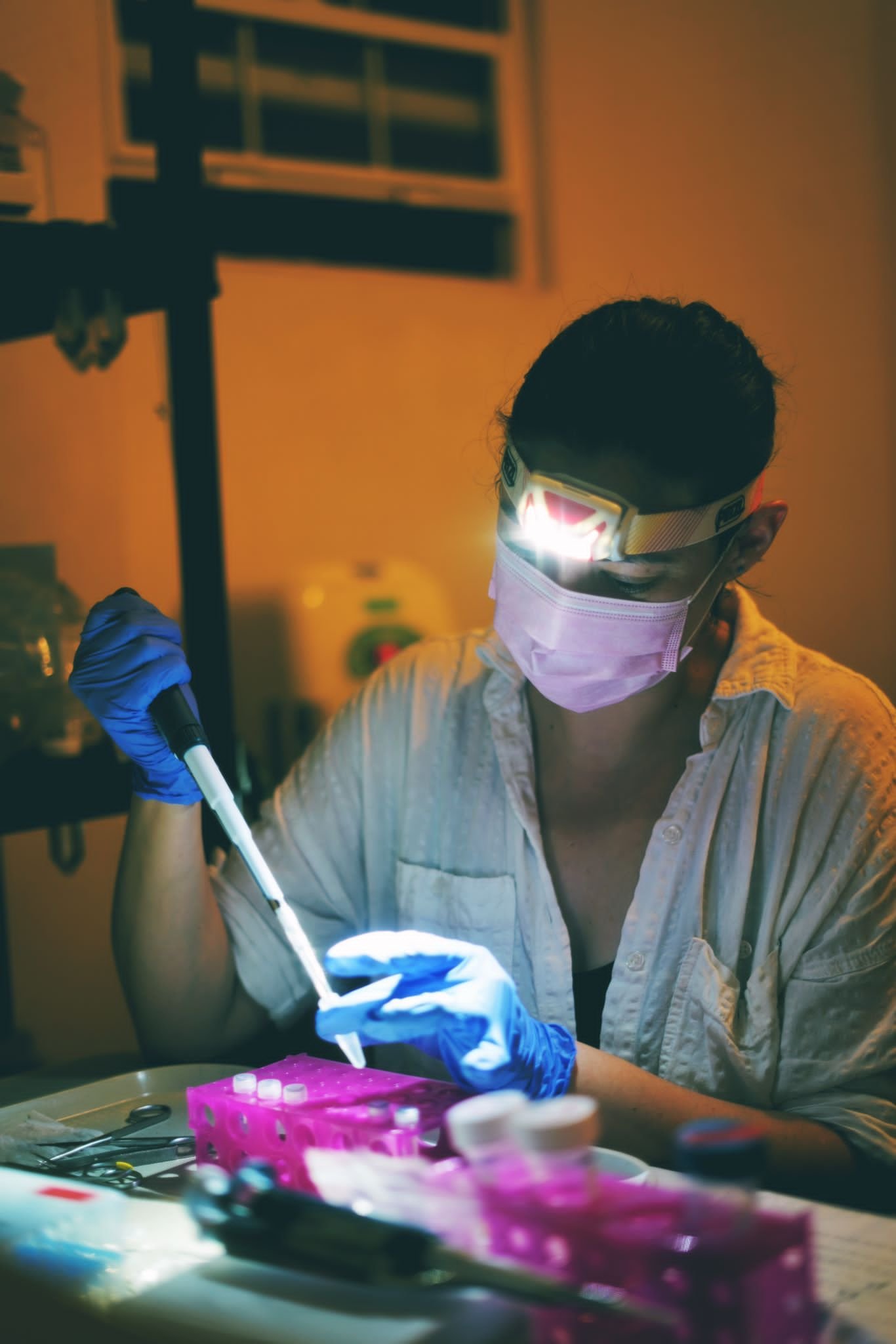
We study how metabolic systems evolve to remain flexible and responsive to environmental change across timescales.
The Evolution of Metabolic Resilience
Jasmin Camacho, Ph.D.
Bioinspired health
About me: As an evolutionary biologist, I am interested in exploring extreme mammalian adaptations for insights into organismal features that might become informative targets for repairing and protecting human health. I received my PhD in Harvard's Organismic and Evolutionary Biology Program in the lab of Dr. Arhat Abzhanov and Dr. Clifford Tabin. I am currently performing research at the Stowers Institute for Medical Research as a Hanna Gray fellow. I am supported by the HHMI, BWF, and NSF.
Research Interests: My research focuses on understanding the origins of adaptations that enhance life—from their single-cell embryonic beginnings to the cultural stories that shape our understanding of these transformative traits. My long-term aim is to uncover the cellular and molecular mechanisms underlying the adaptations of extraordinary mammals.
My research is focused on metabolic physiology through the lens of eco-evo-devo, using biological extremes to uncover how metabolic systems remain flexible and responsive to environmental change. For this, I study bats as a model system. Nectar-feeding bats, in particular, experience high dietary sugar exposure and chronic hyperglycemia yet maintain metabolic health. Many of these species also occupy cave environments, where fluctuating resources and ecological constraints further shape metabolic demands. Together, these conditions provide a natural system to uncover the mechanisms of metabolic resilience.
By identifying how these systems remain stable under conditions that typically lead to dysfunction in other mammals, my work aims to reveal new biological principles of metabolic regulation that can inform strategies to restore metabolic balance in human disease, including hyperglycemia associated with diabetes. These insights provide a framework for preserving metabolic flexibility as a means to prevent age-related decline in physiological function.
Inclusive science is our core value
Higher Education Advocacy: As a first-generation Chicana and Indigenous scholar from an underserved low-income community, I understand firsthand the transformative power of education, and I am committed to advocating for equitable access to higher education. I was born and raised in Salinas, California, the hometown of author John Steinbeck, who often depicted the struggles of the region. These struggles haven’t changed much and in many ways are even sharper now. Families in communities like Salinas are navigating not just poverty and gang violence, but the constant threat of deportation and family separation.
Salinas was home to one of the most violent gangs in the U.S., the Nuestra Familia. The drug pipeline they controlled profoundly affected my own family. My mother dropped out of school and later became entangled in addiction to drugs and alcohol. Despite these harsh realities, I grew up within a tight-knit family and a community rich in culture, strength, and resilience. This is not an unusual story in communities like mine and that is precisely the point.
The barriers to diversifying STEM faculty are not just economic or academic. They are cultural. Science runs on networking, and networking runs on alcohol: at conferences, at dinners, at the informal moments where careers are actually built. This disproportionately excludes Latinos, for whom addiction and its consequences are a shared and often generational wound, and women, who navigate these spaces differently regardless of background. We don't talk about this. We should.
What got me through was not a linear path and that is not an accident. When my PhD advisor left at Harvard, I pivoted. When my postdoc advisor left at the Stowers Institute, I pivoted again. Each disruption required building something more portable, more self-directed, less dependent on a single person's trajectory. What looks like breadth to some is actually the result of having to make my own way, repeatedly, without the safety net that a "linear" path assumes. Even when doors opened (and they did, at places like Harvard and Stowers) the systems inside were not built for someone like me. Advisors, often with the best intentions, are not always equipped to mentor someone navigating this terrain. That is not a criticism. It is a reality. Without someone who truly gets it, not just sympathizes but gets it, even the most well-meaning mentorship can fall short. This is why so many underrepresented scholars leave academia. Not for lack of ability or will, but because the support structures were never built with us in mind.
Latinos don't often have the luxury of stopping. That long road travelled is full of setbacks, upheaval, and the weight of being the first. It is exactly what drives my commitment to address equity by creating a lab for inclusive science.
I am active in SACNAS (Society for Advancement of Chicanos/Hispanics and Native Americans in Science), an organization that understands something many academic spaces do not: that inclusion requires more than an open door. It requires knowing whose cultures and communities you are actually building for. It is a community where I can honor my Chicana and Indigenous (Nahua and Otomí) heritage. The word cihuatl (pronounced see-wah-tl) means 'woman' in Nahuatl. It reflects both the strength and cultural identity I bring to my work as a scientist and a reminder that science has always had room for this knowledge, whether institutions recognized it or not. Integrating this perspective into the lab is part of my commitment to fostering an inclusive research environment that values diversity in thought, experience, and identity.